
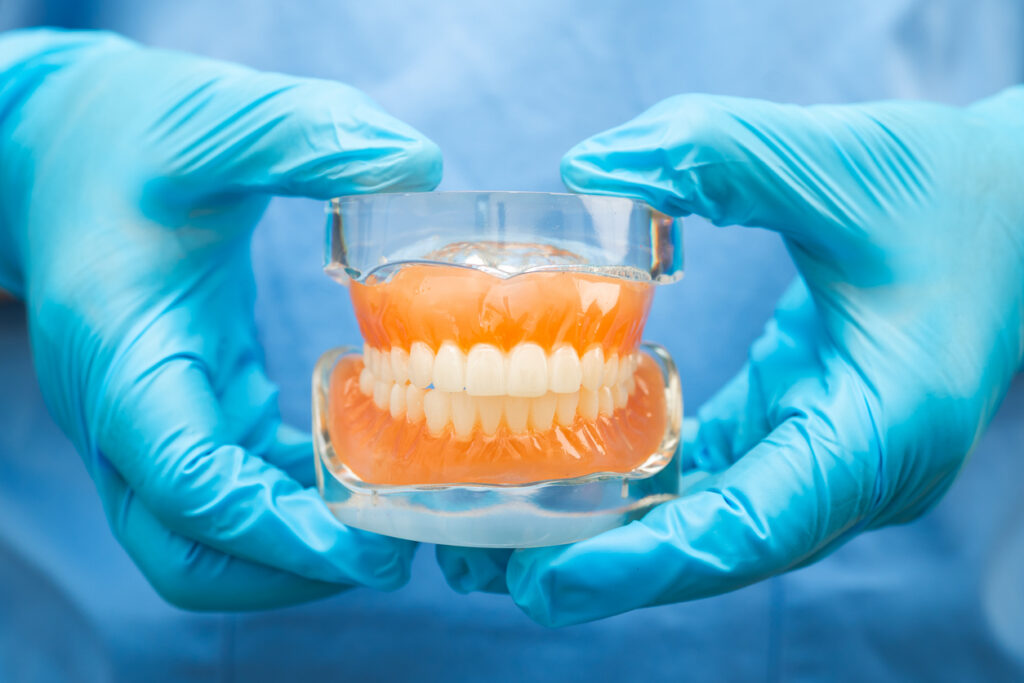
Tooth extractions for denture preparation are a specialized oral surgery procedure that involves removing severely decayed or failing teeth and smoothing the underlying jawbone to create a stable, comfortable, and flush foundation for a custom denture to rest securely. Clinical evidence indicates that dentures placed after extraction serve as a temporary solution during healing [1] (Sikri et al., 2025).
The First 24 Hours: Why Your New Denture Acts Like a Bandage
Medical evidence indicates that oral adhesive bandages are more effective than cotton balls and gauze for hemostasis and comfort in extraction wounds [2] (Zhou et al., 2024). If you opt for immediate, same-day dentures, waking up with a new set of teeth can feel a bit overwhelming. A common instinct is to immediately take the denture out to give your mouth a rest. During the first 24 hours after your extractions, your immediate denture acts exactly like a medical splint or a compression bandage. By keeping it firmly in place, the denture applies steady pressure to your extraction sites. This minimizes post-operative bleeding and drastically reduces facial swelling. If you remove the denture too early, your gums will rapidly swell, making it nearly impossible to put the prosthetic back in. Dr. Barbaro will give you exact instructions on when it is safe to remove and clean your denture for the very first time, usually the day after your surgery.
Table that compares denture transition pathways
Transition pathways | Cost impact | Initial anesthetic and fit | Maintenance level |
Immediate dentures | Moderate | High aesthetic instantly, but the fit loosens as gums shrink | High |
Conventional dentures | Low to moderate | Excellent, permanent fit immediately upon delivery | Low |
Implant-supported dentures | High | Unmatched stability | Moderate |
Why We Might Suggest Keeping a Few Natural Teeth
When patients prepare for dentures, they often assume every single tooth must be pulled. However, our clinical philosophy at Azalea Dental is highly conservative. If you have a few healthy, strong teeth left, we will often recommend saving them. Keeping just two or three healthy teeth completely changes the architecture of your mouth. These remaining teeth can be used to anchor a partial denture, providing massive stability. More importantly, leaving a healthy tooth root in your jawbone preserves the surrounding bone density and stops it from shrinking. By saving what we can, we give you a stronger bite and a much more secure prosthetic fit for the long haul.
The Shrinking Phase
Clinical evidence supports the well-established reduction in the buccolingual and apicocoronal dimensions of the alveolar ridge following tooth extraction [3] (Hansson et al., 2012). Your body is incredibly dynamic. After a tooth is extracted, the empty jawbone and gum tissue will naturally begin to shrink and reshape as they heal. This biological process peaks during the first 3 to 6 months after your surgery. While your gums are shrinking, the hard acrylic of your immediate denture stays exactly the same size. Eventually, the denture will start to feel loose or shift when you speak. To fix the loose fit, we perform a quick, painless procedure called a “soft reline.” We simply add a temporary, cushion-like layer of material to the inside of your denture. This fills the new gaps, stops painful friction, and keeps your smile perfectly snug until your gums have permanently settled.
Retraining Your Bite
Eating after a standard extraction usually means drinking smoothies for a few days. Eating with a new set of dentures requires you to relearn the physics of chewing. Natural teeth are anchored individually into your jaw, but a full denture acts as one single, connected unit. When you transition to solid foods, you cannot simply bite into a hard apple with your front teeth. Doing so will cause the back of the denture to pop up and dislodge. Instead, you must practice “bilateral chewing.” This means cutting your food into small pieces and placing an equal amount on both the left and right sides of your mouth at the same time. Chewing evenly distributes the pressure, keeping your denture locked securely in place.
The Emotional Shift and Speech Adjustments
Recent medical evidence suggests that speech sound difficulties were present before dental treatment in all participants, and the extraction of primary maxillary incisors did not significantly impact speech production [4] (Hurley et al., 2025). At Azalea Dental, we are here to support you through the entire emotional and physical transition. In the first few weeks, your tongue and cheeks are learning how to share space with the new acrylic base. You might produce extra saliva or notice a slight lisp when pronouncing “S” or “F” sounds. This is entirely temporary. The fastest way to overcome this is to read a book out loud or sing along to your favorite music when you are alone in the house or driving around Wilmington. Within a few weeks, your muscle memory will adapt, your speech will return to normal, and you can finally enjoy social events with a confident, pain-free smile.
FAQS
1. Do you do extractions for dentures at Azalea Dental?
Yes, absolutely. We provide comprehensive extraction services specifically tailored for full and partial dentures. Dr. Barbaro evaluates your remaining teeth, maps your jawbone, and performs the gentle extractions necessary to create a perfect foundation for your new prosthetic.
2. Will my jawbone be smooth enough for dentures to fit comfortably?
Yes. During your extraction appointment, our clinical team performs an alveoloplasty.
3. Can I be sedated if I need multiple teeth pulled at once?
Yes. We understand that having multiple teeth removed can feel exhausting.
References
[1] Sikri, A., Sikri, J., Arora, N., Sankhla, B., Gupta, R., & Somanna, M. K. (2025). Immediate Complete Dentures: A Systematic Review. Journal of the West African College of Surgeons, 15(4), 371–379. https://doi.org/10.4103/jwas.jwas_133_24
[2] Zhou, X., Cai, Y., & Zhao, J. (2024). The hemostatic and comforting effects of oral adhesive bandages in tooth extraction: a randomized controlled clinical study. Clinical oral investigations, 28(5), 244. https://doi.org/10.1007/s00784-024-05648-9
[3] Hansson, S., & Halldin, A. (2012). Alveolar ridge resorption after tooth extraction: A consequence of a fundamental principle of bone physiology. Journal of dental biomechanics, 3, 1758736012456543. https://doi.org/10.1177/1758736012456543
[4] Hurley CR, McLeod S, Anthonappa RP. Extraction of primary maxillary incisors and children’s speech production: A case series. Clin Linguist Phon. 2025;39(4-5):427-439. doi:10.1080/02699206.2024.2355481